태권도 역사
HistoryofTaekwondo
“Two thousand years, two lineages, one art. Walk the path from Subak to the Olympic Games.”
57 BC, 668 AD
The Three Kingdoms
SubakandtheHwarang
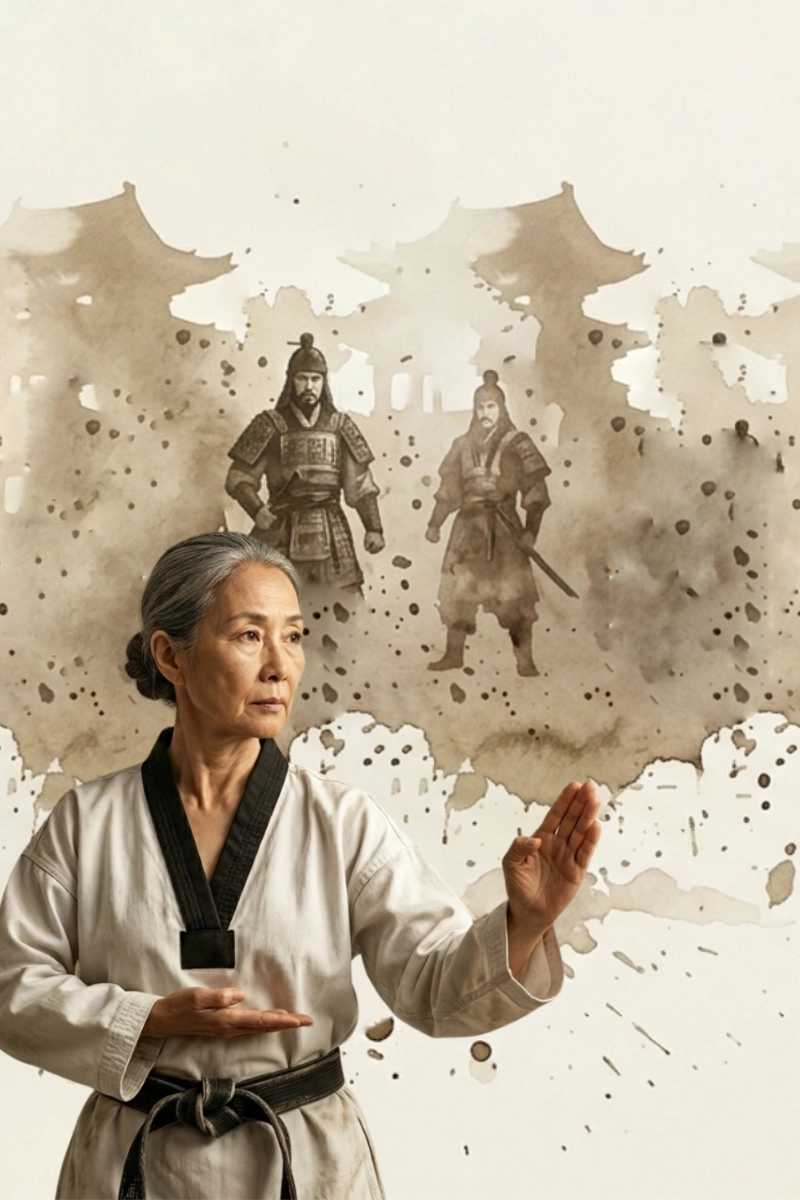
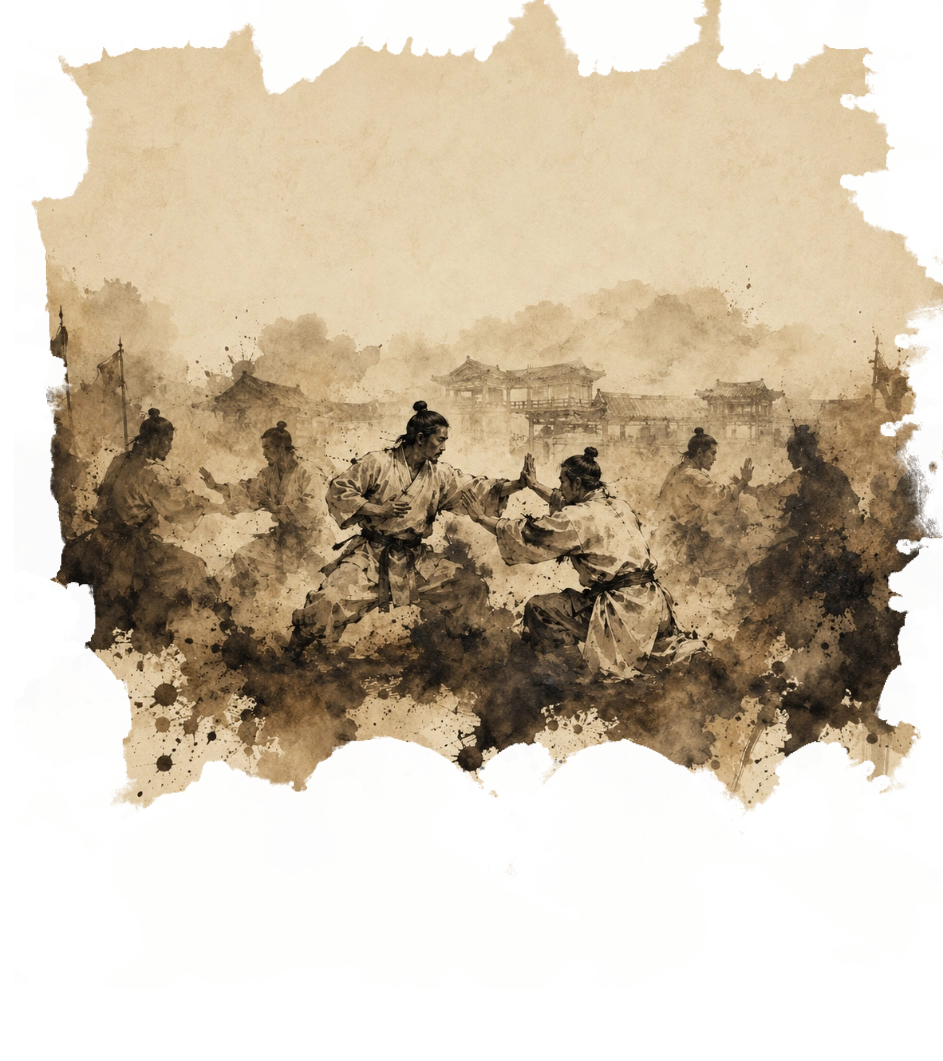
“In the funerary murals of Goguryeo, painted over 1,500 years ago, two warriors face each other in what we now recognize as Subak, the direct ancestor of Taekwondo.”
In the kingdom of Silla, the Hwarang flourished: young elite warriors trained in martial arts, poetry and Buddhist philosophy. Their code of honor, the Sesok Ogye, established loyalty to the king, filial piety, trust among comrades, not retreating in battle, and not killing unnecessarily.
Taekkyeon, the art of the people, was practiced at festivals and ceremonies, with kicks and takedowns in circles of spectators.
“The warrior who knows his art, knows his nation.”
— Hwarang Code
~10th c., 1910
Art of the People
Taekkyeon,theartthatdanced
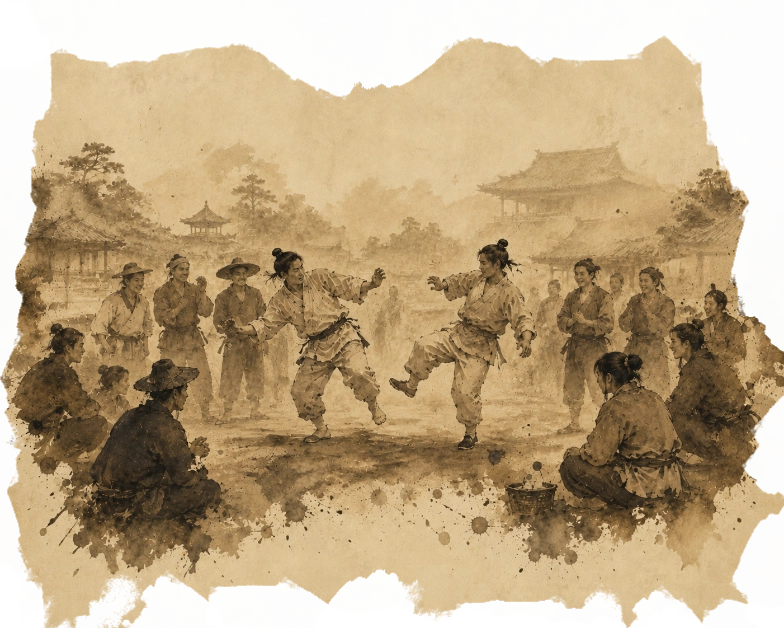
“While Subak was military training, Taekkyeon (태껸) became the art of the common people. During the Goryeo and Joseon periods, it was practiced at festivals like Dano and Chuseok, men competed in circles of spectators with fluid kicks, sweeps and rhythmic takedowns.”
Unlike other combat systems, Taekkyeon had an almost dance-like character: weight transferred from foot to foot with a natural sway, kicks launched in continuity with body movement. It was at once sport, spectacle and art.
Under Japanese occupation (1910-1945) it was suppressed along with all Korean cultural expression. It survived only through secret transmission. Today it is UNESCO Intangible Cultural Heritage (2011), the only martial art in the world with that recognition.
“Taekkyeon is not fought, it is danced with the opponent.”
— Master Song Duk-ki (last great Taekkyeon master, 20th c.)
1910 – 1945
Occupation and Resistance
Theartthatsurvived
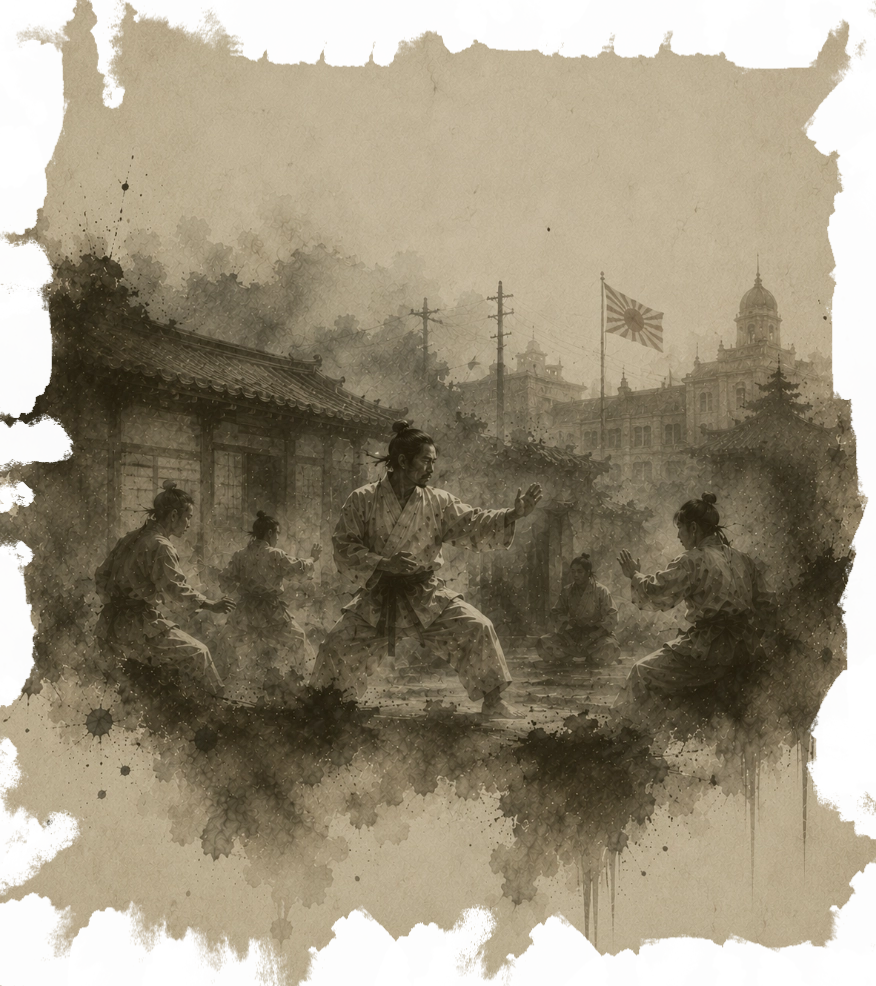
“When the Japanese Empire occupied Korea in 1910, it banned native martial arts. Taekkyeon survived underground, passed from master to student in secret.”
Paradoxically, many Koreans traveled to Japan and learned Karate (Shotokan, Shudokan, Goju-ryu). Upon returning, they fused those techniques with their native roots.
Liberation in 1945 opened the doors. The masters who had preserved the knowledge began teaching openly, sowing the seeds of what was to come.
“You cannot destroy an art that lives in the bodies of its people.”
— Korean oral tradition
1945 – 1966
Birth
The9Kwansandaname
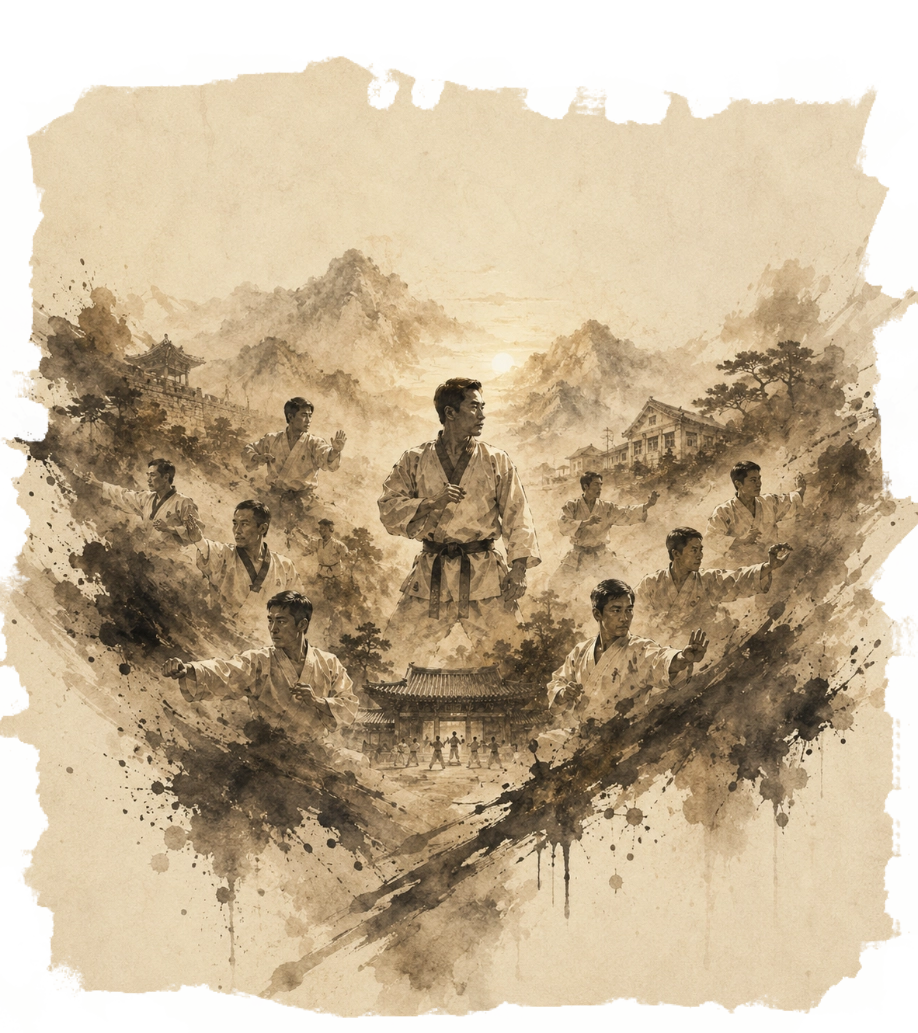
“From 1945 to 1955, the 9 original schools (Kwans) emerged: Chung Do Kwan, Moo Duk Kwan, Yun Moo Kwan, Chang Moo Kwan, Oh Do Kwan, Ji Do Kwan, Chi Do Kwan, Sang Moo Kwan and Song Moo Kwan. Each with its founder, its own style, its lineage.”
On April 11, 1955, in a contest convened by General Choi Hong Hi, the name 跆拳道, Taekwondo, was officially chosen. Tae (태): to destroy with the foot. Kwon (권): to destroy with the fist. Do (도): the way.
In 1959 the Korea Taekwondo Association (KTA) was founded, the first national organization that unified the 9 Kwans under a single federation.
“It is not just a martial art. It is a way.”
— Meaning of 道 (Do)
1966 – 1973
The Split
ITFvsWTthegreatschism
“Between 1966 and 1973, deep differences emerged over the direction of Taekwondo: its philosophy, its organization, and its place on the international stage.”
On November 30, 1972, the South Korean government inaugurated the Kukkiwon in Seoul, the World Headquarters of Taekwondo. On May 28, 1973 the World Taekwondo Federation (WTF), now World Taekwondo (WT), was born.
Two lineages, one origin. The division persists today: each branch developed its own technical identity, its forms, its rules, and its vision of the art. Choose a branch to discover its full history.
“From one seed, two trees. From the same soil, different fruit.”
— ITF / WT Division
1966 · 1973 · The great schism
Herethepath
divides
“Two lineages born from one origin.
Choose your branch to continue.”
Quick guide
The history of taekwondo in brief
Short answers to the most common questions about where taekwondo comes from and how it evolved.
Frequently asked questions
Who created taekwondo?
No single person created it. General Choi Hong Hi drove the adoption of the name “taekwondo”, approved on April 11, 1955, and founded the ITF in 1966. The art itself took shape from 1945 in several Korean schools, blending the country’s ancient martial arts with the influence of karate.
When was taekwondo created?
The name dates from 1955, and modern taekwondo took shape after 1945. It is also linked to Korean arts more than 1,500 years old, such as subak. Key dates: ITF (1966), Kukkiwon (1972) and World Taekwondo (1973).
Where does taekwondo come from?
Korea. It is linked to ancient Korean martial arts such as subak and taekkyeon (the latter listed by UNESCO as Intangible Cultural Heritage of Humanity since 2011), and took its current form in Korea after 1945.
What does taekwondo mean?
Tae (태, 跆) is foot or kick, kwon (권, 拳) is fist, and do (도, 道) is the way. Together: “the way of the foot and the fist”.
What is the difference between ITF and WT?
They are the two main branches of taekwondo. The ITF was founded by Choi Hong Hi in 1966 and practices the Chang Hon patterns (tul). World Taekwondo, formerly the WTF, was born in 1973 in Seoul, is the Olympic branch and practices the Taegeuk poomsae and sparring with electronic scoring.
When did taekwondo become an Olympic sport?
It was a demonstration sport at Seoul 1988 and Barcelona 1992. The IOC approved it as an official sport in 1994, and it made its medal debut at Sydney 2000.
What is the Kukkiwon?
The world headquarters of WT taekwondo, in Seoul. Founded in 1972, it certifies Dan (black belt) grades of this branch worldwide.
How Olympic taekwondo changed
After the Sydney 2000 debut, sparring changed with technology. Since London 2012, electronic body protectors record the points and video replay is used to review the action.
Taekwondo history by country
Every country has its own story, with the ITF and WT branches told separately.
- ArgentinaWT · ITF
- BoliviaWT · ITF
- BrazilWT · ITF
- CanadaWT · ITF
- ChileWT · ITF
- ColombiaWT · ITF
- CubaWT · ITF
- EcuadorWT
- FranceWT · ITF
- GermanyWT · ITF
- IranWT
- ItalyWT · ITF
- JapanWT
- MexicoWT · ITF
- PanamaWT
- ParaguayWT · ITF
- PeruWT · ITF
- reino unidoWT · ITF
- South KoreaWT
- SpainWT · ITF
- United StatesWT · ITF
- UruguayWT · ITF
- VenezuelaWT · ITF
Keep reading
- Choi Hong Hi and Kim Un-yong: the Two Figures Who Defined Taekwondo
- Sydney 2000: the day Taekwondo debuted as an Olympic sport
- How Taekwondo Came to Colombia: Pioneers, Masters, and Foundational Dojangs
- Mexico and Taekwondo: Reynoso, Espinoza and the Generation That Opened the Door
- Kukkiwon: the Seoul cathedral that defines WT Taekwondo
- The great 1966 split: why the ITF was born, and then the WT
- What is the Kukkiwon: the cathedral of WT Taekwondo in Seoul
- Choi Hong Hi: the general who named Taekwondo in 1955